# About me
My name's Lui. I'm a computer science (soon-to-be computer engineering!) student in university. I have a deep passion for technology. I spend a lot of my liminal "free" time (breaks, bus rides, waiting rooms..) reading hacker news, catalyzing all my willpower into stopping myself from getting into online arguments at every 3 comments I read on that god-forsaken forum, reading through personal blogs from random professionals I somewhat respect, or just researching whatever my Current Obsession™ is at the moment.
I'm somewhat of an eccentric idealist, especially when it comes to tech and programming, with my main areas of interest being permacomputing, OS development, embedded development, functional programming languages such as Lisp and Haskell, and other more academia-locked concepts and languages such as Prolog, Forth, Lisp Machines, and others.
I've taught myself the vast majority of my knowledge in these fields over the years, since early highschool all the way to now, and that'll probably remain the case even while I make my way through university. I have a much easier time learning when I look things up and experiment on my own rather than sitting in a class listening to a teacher for 3 hours straight.
Whenever I have longer sections of free time (excluding time spent on personal recreational projects and research), I tend to play video games, mostly older titles or indie games lately. For most of my life I was a competitive multiplayer enjoyer exclusively; all I did was play Counter-Strike, Dota, Rainbow Six Siege and other similar titles. As of the last couple years though I slowly transitioned into more casual multiplayer, almost exclusively Team Fortress 2 and variants (Open Fortress, Team Fortress Classic, etc), and then into nothing but solo local experiences for over a year now. I've been playing through all the Soulsborne games, lots and lots of roguelikes such as The Binding of Isaac, and a healthy dose of older classics such as the original Quake.
I also really like reading, and there are some months (especially during uni) where I don't play games at all and spend all my free time reading. I mostly read sci-fi or horror (often some mix of the two), although I also enjoy more grounded titles such as "No Longer Human" by Osamu Dazai. Some of my favorite books, including the one I just mentioned, are "The Metamorphosis of Prime Intellect", "Brave New World", and "Neuromancer". I also read a lot of manga, mostly focusing on seinen such as "The Climber", "Vagabond", "Vinland Saga" and similar titles.
Otherwise, I love being outdoors. I'm a huge fisherman, although somewhat of a failed one as I catch very few fish, but I still love being out on the water even if I get no bites. Similarly, I love backpacking, camping and hiking. I'm also very interested in radio, although I've found it to be a very hard hobby to get into. I've mostly been researching and watching from afar, with my only real radio equipment being a cheap RTL-SDR dongle (for now! I can definitely see myself spending way too much money in this hobby...). I also love tabletop RPGs and such. When I was about 11 or 12 I used to handcraft D&D maps and campaigns for an imaginary party (I didn't know anybody who played back then..), but nowadays I get to actually play with friends like once a year or something, which is better than nothing.
# About readthemanpage.dev
Creating this website has been on my development bucket list for a long time. The name, style, and tech stack behind it had been decided long before I actually got off my ass and started developing it. The name readthemanpage comes from, obviously, the ever-comical expression "RTFM", but also from the sense of admiration and wonder I felt towards man pages when I first started writing C on Linux; especially the libc man pages that almost acted as a local documentation to the language itself. Writing C nearly became a blissful experience after I learned to navigate that local documentation, along with a healthy dose of reading source code already present on my system. It made me feel like I could create anything I wanted in my dev environment without so much as an internet connection.
Now, looking back, man pages really aren't that amazing. Even though I can't help but see it as bloat, Rust's docs generation seems a lot more powerful, while also remaining local. But C man pages will always have a special little spot in my heart for some reason, so I decided to keep the name. I also think it sounds pretty cool, so why not.
The whole look and style are heavily inspired by my own development environment. The colors come from my Emacs theme, [quasi-monochrome]. Most colors here are a straight copy-and-paste from that theme. The general visual direction of the website is terminal / text editor.
Fittingly, every single post you see here is written in markdown. Even this one.
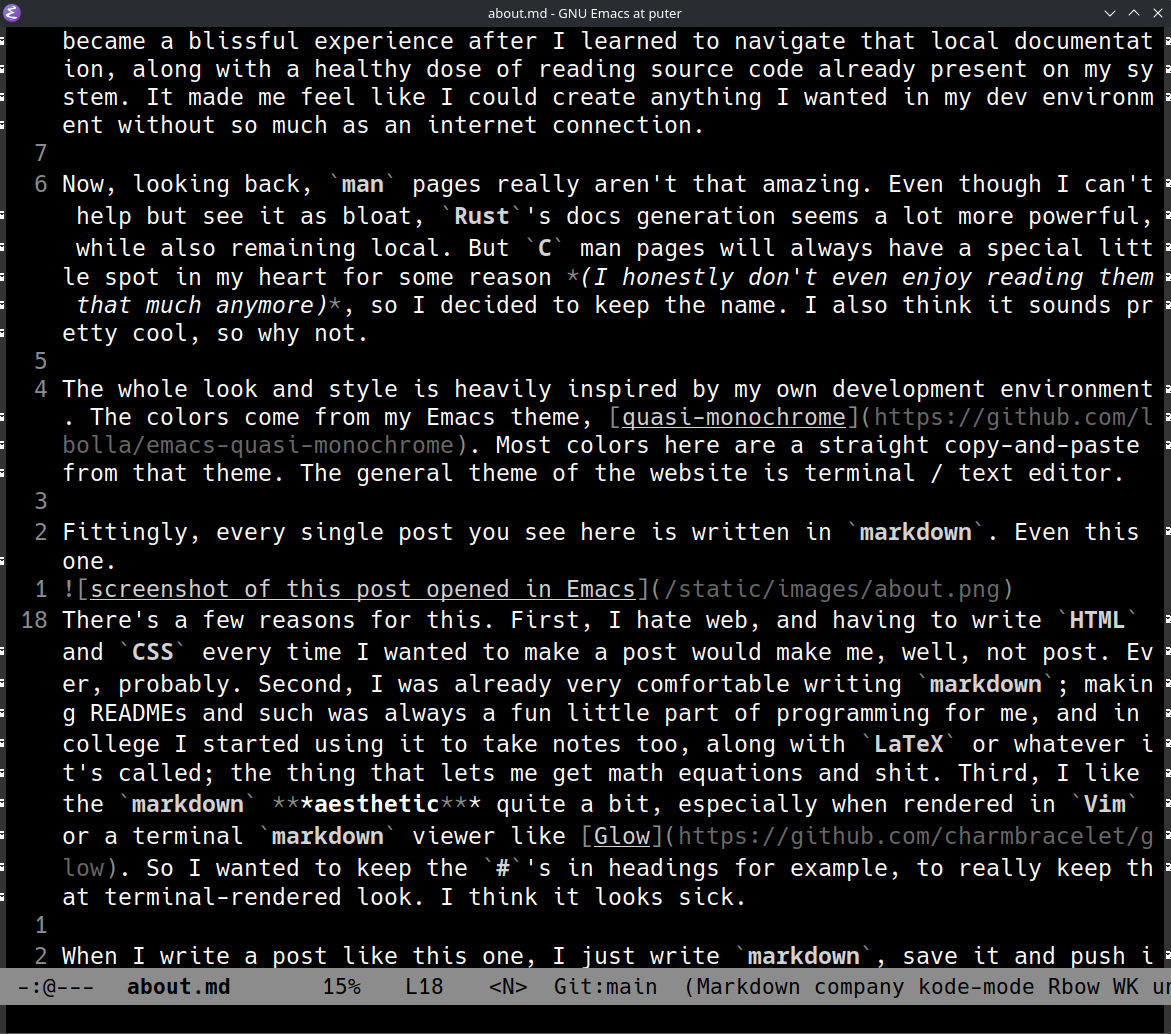

There are a few reasons for this. First, I strongly dislike the web: it's an ugly, brittle, slow and overly bloated platform and having to write HTML and CSS every time I wanted to make a post would make me, well, not post. Ever, probably. Second, I was already very comfortable handwriting markdown; making READMEs and such was always a fun little part of programming for me, and in college I started using it to take notes too, along with LaTeX. Third, I like the markdown aesthetic a lot, especially when rendered in Vim or a terminal markdown viewer like [Glow]. So I wanted to keep the #'s in headings for example, to really keep that terminal-rendered look. I think it looks sick.
When I write a post like this one, I just write markdown on Emacs, save, commit and push, and you get what you're seeing right now instantly. My content directory is read on-the-fly and the markdown files are converted to HTML on demand, so I never have to write any of that by hand. However, I can't take as much pride in this project as I would've liked to, simply due to the fact that this was my first AI-assisted programming project. I'm usually completely agaisnt even touching LLMs for personal projects, but I also didn't want to take some free-code-camp course on web or whatever, I already had the programming skills, I just needed them applied to the browser, and AI was the best tool for this job.
While this project taught me a lot, I didn't quite like the feeling of "this project is out of my hands"; It was weird, especially considering I'm someone who likes having complete control over my computer and code. Somewhat surprisingly to me, the LLM actually did a pretty good job, all things considered, which I'm simultaneously very pumped and very sad about. Admittedly, this project is very small: Just two python files, one to parse and manage the markdown and one to manage the entrypoints with Flask, two big CSS stylesheets, a few Jinja2 templates, and the stagit-based framework to make the self-hosted mirrors work. But what would've taken me a week of work to do by myself took Gemini one night and a good part of the day after. Well, Gemini and I, as in reality I had to correct its ugly code, bugs and hallucinations all the time, redirect it to get my very specific stylistic needs, and occasionally insult it when it got too crazy or took more than 2 tries to fix/implement something. But I still didn't have to scour the python and Flask documentation to make entrypoints work, or take a small course on webhosting and nginx and such. I wrote maybe 5 lines of CSS and changed a few small sections in the HTML templates by hand, but the rest was mostly done through prompting. Make of that what you will.
That's about all I have to say about this website for now. You can look at my [posts] for more.
AI DISCLAIMER: I never use, have used or will ever use AI for writing or reviewing ANY of the text I write on this blog. I may use it to find a very specific word for something I'm trying to say, or just spotting grammar and punctuation mistakes, but nothing beyond that. There's more than enough slop in this world.
I'll probably write my thoughts on AI on a later bigger post as that's not the focus of this page.
# ~/about.md